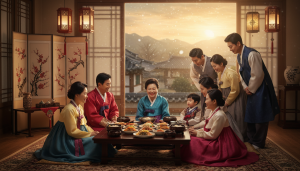

Chuseok, often referred to as the Korean Thanksgiving, is arguably the most significant traditional holiday in South Korea. Celebrated on the 15th day of the 8th month of the lunar calendar, it is a time when families gather to give thanks to their ancestors for an abundant harvest. The name ‘Chuseok’ literally translates to ‘Autumn Eve,’ capturing the essence of the season where the summer heat dissipates, and the cool breeze of fall begins to settle. It is a period marked by deep cultural resonance, blending ancient agricultural rituals with Confucian family values.
Also known as ‘Hangawi,’ an archaic Korean term, the holiday represents the middle of autumn. ‘Han’ means big, and ‘Gawi’ refers to the middle of the 8th lunar month. Consequently, a famous Korean proverb states, ‘No more, no less, may it just be like Hangawi,’ wishing for a life as abundant and generous as this harvest festival. While the world may know it superficially as a harvest festival, the intricacies of Chuseok reveal a complex tapestry of history, gastronomy, and spirituality that defines the Korean identity.
The Historical Origins of Chuseok
The origins of Chuseok are steeped in history, dating back to the Silla Kingdom (57 BC – 935 AD). According to historical texts like the Samguk Sagi, the third king of Silla, King Yuri, established a month-long weaving competition known as ‘Gabae.’ Two teams of women, led by princesses, would compete to weave the most cloth. On the 15th day of the 8th month, the losing team would prepare food and wine for the winners, resulting in a grand festival filled with music, dance, and games. This event is widely considered the precursor to the modern Chuseok celebration.
While Gabae focused on community and weaving, the agricultural aspect of Chuseok is undeniable. As an agrarian society, ancient Koreans relied heavily on the harvest moon to track time and agricultural cycles. The full moon during Chuseok is often the largest of the year, symbolizing fertility and abundance. Consequently, the holiday became a focal point for praying for a good harvest in the coming year and thanking the heavens for the crops already gathered.
Ancestral Rites: Charye, Seongmyo, and Beolcho
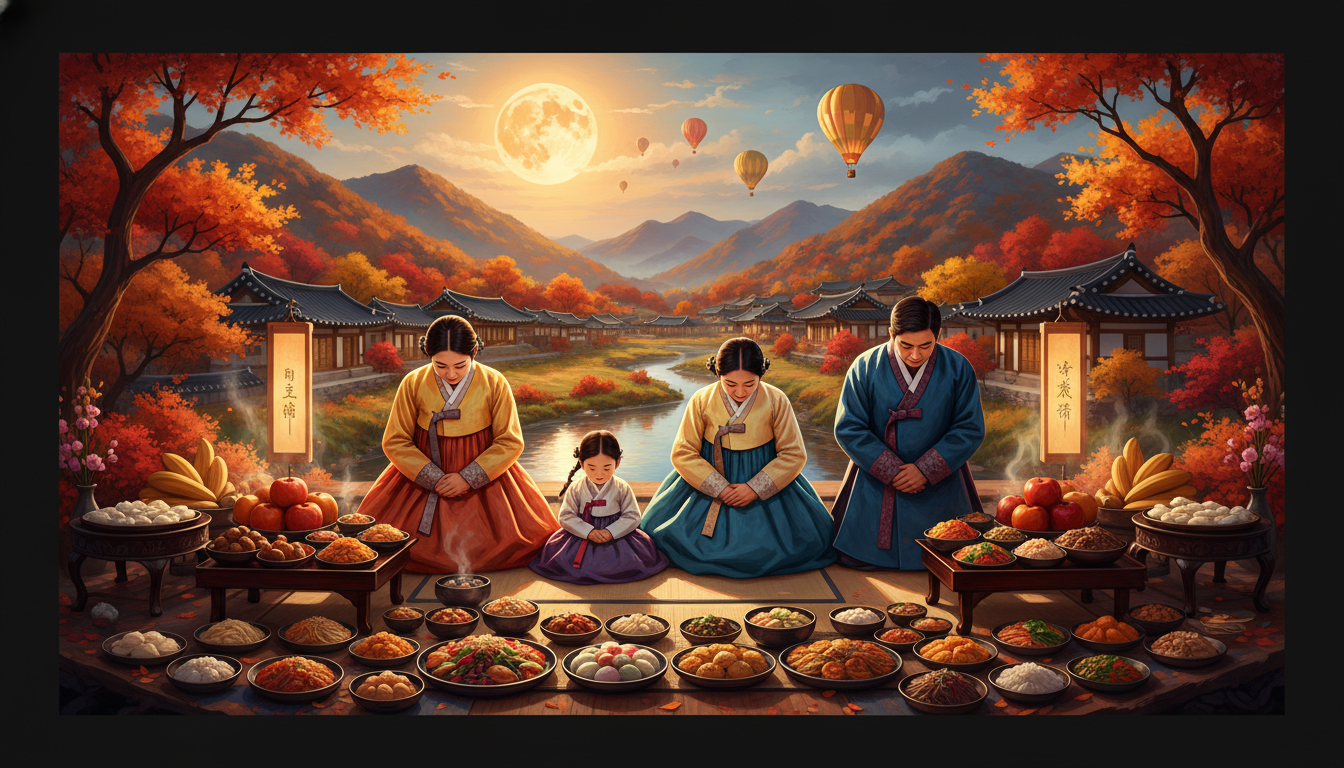
At the core of Chuseok lies the veneration of ancestors, a practice deeply rooted in Confucianism. The morning of Chuseok begins with ‘Charye,’ a memorial service held at the family home. During Charye, fresh harvest foods are arranged on a ritual table to honor the family’s ancestors for the past four generations. This is not merely a religious act but a way to affirm family lineage and cohesion. The arrangement of food on the table follows strict rules, such as placing red foods on the east and white foods on the west.
Following the indoor rites, families often visit their ancestral graves, a practice known as ‘Seongmyo.’ This is accompanied by ‘Beolcho,’ the act of clearing weeds and tidying the grave site. Beolcho is typically done a few weeks before Chuseok to ensure the graves are presentable for the holiday. It is considered a filial duty; a neglected grave is seen as a sign of undutiful descendants. These traditions emphasize the Korean belief that the spirits of ancestors remain with the family and protect them.
The Culinary Landscape of Hangawi
No discussion of Chuseok is complete without mentioning the food. The quintessential Chuseok delicacy is ‘Songpyeon,’ a half-moon-shaped rice cake. Made from rice powder dough and filled with sesame seeds, red beans, chestnuts, or honey, Songpyeon is steamed over a layer of pine needles, which imparts a distinct aroma. Interestingly, while the moon is full during Chuseok, the cakes are shaped like half-moons. This symbolizes the potential for growth and progress, as a half-moon eventually becomes full, whereas a full moon only wanes.
Other Traditional Delicacies
Beyond Songpyeon, the Chuseok table is laden with ‘Jeon’ (Korean pancakes) and ‘Japchae’ (stir-fried glass noodles). Jeon is made by coating fish, meat, or vegetables in flour and egg wash before pan-frying. The preparation of these dishes is labor-intensive, often requiring the women of the household to spend days in the kitchen, although modern gender roles are slowly changing this dynamic. Another staple is ‘Baekju,’ a traditional white liquor made from freshly harvested rice, which is consumed and offered to ancestors.
Folk Games and Cultural Entertainment
Chuseok is also a time for traditional folk games that strengthen community bonds. One of the most famous is ‘Ganggangsullae,’ a circle dance performed by women under the full moon. Originating from the Joseon Dynasty, legend has it that Admiral Yi Sun-sin used this dance as a military tactic to deceive the Japanese army into thinking his troops were more numerous than they actually were. Today, it is a UNESCO Intangible Cultural Heritage item.
For men, ‘Ssireum,’ or traditional Korean wrestling, is the highlight. Two competitors grasp each other’s ‘satba’ (a belt worn around the waist and thigh) and attempt to force their opponent to the ground. Historically, the winner of the village Ssireum tournament would receive a calf as a prize, a highly valuable asset in an agricultural society. These games serve as a release of energy and a celebration of communal strength.
54 Fascinating Facts About Chuseok
To fully appreciate the depth of this holiday, here is a curated list of facts that cover the spectrum of Chuseok traditions, history, and modern adaptations:
Historical and Cultural Facts:
- 1. Chuseok is one of Korea’s three major holidays, alongside Seollal (Lunar New Year) and Dano.
- 2. The holiday lasts for three days: the day before, Chuseok day, and the day after.
- 3. The date fluctuates annually on the Gregorian calendar as it follows the lunar cycle.
- 4. ‘Hangawi’ is the pure Korean name for the festival.
- 5. King Yuri of Silla is credited with starting the tradition through weaving competitions.
- 6. The full moon at Chuseok is associated with fertility and a good harvest.
- 7. Ancient Koreans believed the moon was brighter on Chuseok than any other night.
- 8. Weaving cloth (Gilssam) was a primary competitive activity in ancient times.
- 9. The holiday marks the transition to cooler autumn weather.
- 10. It is a time to wear ‘Chuseokbim,’ a new set of traditional Hanbok clothes.
Food and Ritual Facts:
- 11. Songpyeon is steamed with pine needles (sol-ip) for preservation and flavor.
- 12. A superstition says making beautiful Songpyeon leads to having a beautiful daughter.
- 13. Toran-guk (taro soup) is a medicinal soup often eaten during Chuseok.
- 14. Newly harvested rice used for the festival is called ‘Sinmai.’
- 15. The arrangement of the Charye table is dictated by the principle of ‘Hong-dong-baek-seo’ (Red East, White West).
- 16. Fish is placed with the head pointing east and tail west (‘Du-dong-mi-seo’).
- 17. Fruits are usually the top layer of the ritual table.
- 18. Hangwa, traditional Korean confectionery, is a common dessert.
- 19. Liquor offered to ancestors is usually cleared away and drunk by the family (‘Eumbok’).
- 20. Pears and apples used for Chuseok are often premium, large-sized gifts.
Social and Modern Facts:
- 21. The ‘Great Exodus’ occurs as millions travel from Seoul to their hometowns.
- 22. Highway tolls are often waived by the government during the holiday.
- 23. Train tickets for Chuseok sell out within minutes of release.
- 24. Spam gift sets are among the most popular corporate Chuseok gifts in Korea.
- 25. Other popular gifts include cooking oil, tuna cans, and expensive fruit baskets.
- 26. Many young Koreans now use the holiday to travel abroad instead of visiting home.
- 27. ‘Holiday Syndrome’ is a recognized stress condition affecting housewives due to excessive cooking.
- 28. Department stores generate a significant portion of their annual revenue during this season.
- 29. Movie theaters often release blockbusters tailored for family audiences during Chuseok.
- 30. Leftover food, particularly Jeon, is often repurposed into spicy stews (Jeon-jjigae).
Games and Folklore Facts:
- 31. Ganggangsullae is exclusively performed by women.
- 32. Ssireum matches are often broadcast on national television.
- 33. ‘Juldarigi’ (tug-of-war) is another common village game involving rice straw ropes.
- 34. ‘Sog-nori’ involves villagers dressing as cows and going door-to-door for food.
- 35. Archery was a traditional pastime for nobility during Chuseok.
- 36. Cockfighting (Dak-ssaum) is a popular children’s game (played by hopping on one leg).
- 37. Kite flying is less common in autumn but still practiced in some regions.
- 38. Viewing the full moon (Dal-maji) involves climbing a hill to make a wish.
- 39. The first person to see the moon is believed to have the best luck.
- 40. Rabbits are associated with the moon in Korean folklore (pounding rice cakes).
Miscellaneous Facts:
- 41. Banks and public offices are closed for the duration of the holiday.
- 42. In North Korea, Chuseok is also celebrated, but visiting graves is the primary focus.
- 43. The tradition of Beolcho has spawned professional landscaping services for those too busy to cut weeds.
- 44. Confucian academies (Seowon) hold special rites during this time.
- 45. Traditional markets see a massive surge in visitors before supermarkets.
- 46. The phrase ‘Deo-do mal-go, deol-do mal-go’ is the most famous Chuseok greeting.
- 47. Ancestral rites are traditionally led by the eldest son.
- 48. Christianity in Korea has adapted Chuseok, often replacing Charye with family prayer services.
- 49. Single people often dread the holiday due to relatives asking about marriage plans.
- 50. Pet-friendly Chuseok gifts and Hanboks for dogs are a growing trend.
- 51. Convenience stores sell solo-dining Chuseok bento boxes for those not visiting family.
- 52. The harvest moon is sometimes called the ‘Potato Moon’ in other cultures, but in Korea, it’s strictly rice-centric.
- 53. Traditional liquor consumption spikes significantly.
- 54. Despite modernization, the core value of ‘Hyo’ (filial piety) remains the holiday’s anchor.
The Evolution of Gift-Giving Culture
Gift-giving is an integral part of Chuseok, evolving from sharing harvest crops to exchanging manufactured goods. In the 1950s and 60s, necessities like sugar, soap, and condiments were prized gifts. By the 1970s, as the economy grew, coffee sets and vegetable oil became popular. The 1990s saw the rise of health supplements like ginseng and vouchers. Today, while premium beef (Hanwoo) and fruit remain top-tier gifts, the ubiquity of Spam gift sets is a unique Korean cultural phenomenon, rooted in the post-war era when processed meat was a luxury.
Modern Chuseok: Changes and Challenges
While traditional values persist, Chuseok is undergoing significant changes. The intense labor required for food preparation has led to intergenerational conflict, prompting some families to order pre-made ritual food or dine out. Furthermore, the concept of ‘D-turn’ or ‘Reverse-turn’ has emerged, where parents travel to the city to visit their children to save them from traffic, or families meet at a vacation destination.
Despite these shifts, the essence of Chuseok remains a celebration of gratitude and family. Whether through a solemn ancestral rite or a casual family meal, the holiday serves as a vital link between Korea’s past and present. As society modernizes, the ways in which Koreans express ‘Hyo’ and celebrate abundance may adapt, but the spirit of the Harvest Moon continues to illuminate the peninsula.