
Taekwondo is far more than a simple system of self-defense or a popular Olympic sport; it is a profound expression of the Korean soul and a cultural bridge that connects the ancient past with the modern world. For millions of practitioners across the globe, Taekwondo offers a path to physical fitness and mental discipline, but its origins are deeply intertwined with the history of the Korean Peninsula. In this detailed exploration, we uncover 26 fascinating facts that highlight why Taekwondo remains one of the most respected martial arts in the world and how it continues to shape Korean cultural identity today.
The Historical Foundations of Taekwondo
Fact 1: Ancient Origins in Goguryeo. The roots of Taekwondo can be traced back over 2,000 years to the Three Kingdoms period of Korea. Mural paintings found in royal tombs such as Muyongchong, dating back to the Goguryeo Dynasty (37 BC – 668 AD), depict figures performing techniques that are strikingly similar to modern Taekwondo stances and strikes. This suggests that the foundations of the art were already being laid in ancient times as a means of tribal defense and physical training.
Fact 2: The Hwarang Warriors of Silla. During the Silla Dynasty, an elite group of young noblemen known as the Hwarang (Flower Knights) was formed. They were trained in various martial arts, including Subak, which is a precursor to Taekwondo. The Hwarang followed a strict code of ethics and played a crucial role in unifying the Korean Peninsula, embedding a sense of chivalry and moral discipline into the martial traditions that would later define Taekwondo.
Fact 3: The Influence of Taekkyeon. Before the modern era, Taekkyeon was the dominant folk martial art in Korea. Known for its fluid, dance-like movements and rhythmic footwork, Taekkyeon heavily influenced the kicking techniques that Taekwondo is famous for today. While Taekwondo became more structured and linear over time, the spirit of Taekkyeon’s agility remains a core component of its technical DNA.
Fact 4: The Official Naming in 1955. Despite its ancient roots, the name ‘Taekwondo’ is relatively modern. It was officially adopted on April 11, 1955, during a meeting of masters from the various ‘Kwans’ (martial arts schools). General Choi Hong-hi is widely credited with proposing the name, which was chosen for its descriptive accuracy and its connection to the traditional art of Taekkyeon.
The Philosophy and Symbolic Meaning
Fact 5: The Literal Translation. The word Taekwondo is composed of three Korean Hanja characters: Tae (meaning to strike or break with the foot), Kwon (meaning to strike or break with the fist), and Do (meaning the way or the path). Together, they translate to ‘The Way of the Foot and the Fist,’ emphasizing that the art is a holistic journey of both physical prowess and spiritual growth.
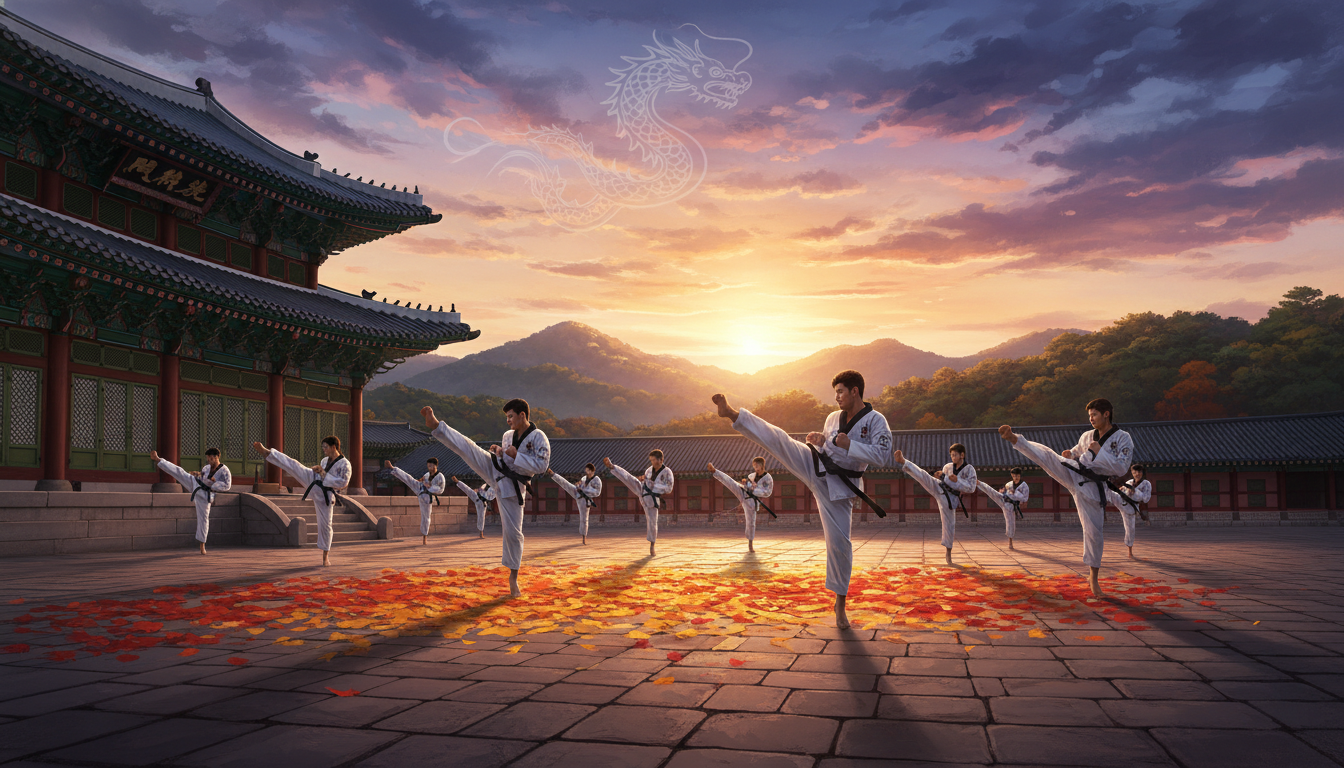
Fact 6: The Symbolism of the Dobok. The traditional uniform, known as the Dobok, is rich in symbolism. The white color of the fabric represents purity and the ‘white-clad people’ (baek-ui-min-jok), a traditional moniker for Koreans. The circular, square, and triangular shapes often found in the design of the uniform represent the sky, the earth, and humanity, respectively, reflecting the Eastern philosophical concept of the trinity.
Fact 7: The Five Tenets. Every practitioner is expected to live by five core tenets:
- Courtesy (Ye-Ui): Showing respect to instructors and peers.
- Integrity (Yom-Chi): Knowing right from wrong and having a guilty conscience when one is wrong.
- Perseverance (In-Nae): The will to continue despite difficulties.
- Self-Control (Geuk-Gi): Maintaining composure in and out of the dojang.
- Indomitable Spirit (Baek-Jeol-Bul-Gul): The courage to stand up for what is right regardless of the odds.
Fact 8: The Philosophy of Um-Yang. Much like the Taegeuk symbol on the South Korean flag, Taekwondo philosophy is built on the concept of Um-Yang (Yin and Yang). It represents the balance of opposing forces: hard and soft, fast and slow, offensive and defensive. A true master learns to balance these forces to achieve harmony in their movements and their life.
The Language of Color: The Belt System
Facts 9-13: The Journey Through the Belts
The belt system in Taekwondo is a visual representation of a student’s progress and maturity. Fact 9: White Belt represents the innocence of a beginner with no prior knowledge. Fact 10: Yellow Belt symbolizes the earth in which a plant takes root, signifying the foundation of the art. Fact 11: Green Belt represents the plant’s growth as Taekwondo skills begin to develop. Fact 12: Blue Belt signifies the sky toward which the plant matures into a towering tree. Fact 13: Red Belt denotes danger, cautioning the student to exercise control and warning opponents of their skill.
Fact 14: The Black Belt Paradox. While many see the black belt as the end of the journey, in Korean culture, it is often viewed as the true beginning. A black belt signifies that the student has mastered the basics and is now ready to walk the ‘Way’ with a deeper understanding. There are nine levels of black belt (Dans), with the higher ranks reserved for those who have dedicated decades to the art.
Technical Mastery and Training Methods
Fact 15: The Science of High Kicks. Taekwondo is world-renowned for its emphasis on kicking. Historically, jumping and flying kicks were developed to knock Mongolian horsemen off their mounts. Today, these techniques are refined through physics, utilizing centrifugal force and hip rotation to generate incredible power that can exceed the force of a professional boxer’s punch.
Fact 16: The Power of the Kihap. The Kihap is the spirited shout heard during training. It serves multiple purposes: it tightens the abdominal muscles to protect the core, increases the power of the strike through controlled breathing, and serves to intimidate the opponent while focusing the practitioner’s internal energy (Ki).
Fact 17: Poomsae (Forms). Poomsae are choreographed sequences of movements that simulate a fight against multiple imaginary attackers. Each Poomsae is designed to teach specific stances, blocks, and strikes. In modern competition, Poomsae has become a recognized discipline where practitioners are judged on their precision, power, and artistic expression.
Fact 18: Gyeokpa (Breaking). The practice of breaking boards, bricks, or tiles is known as Gyeokpa. This is not just for show; it is a vital test of a practitioner’s accuracy, power, and mental focus. It proves that the techniques learned in class can be applied with devastating effectiveness if necessary.
Taekwondo on the Global Stage
Fact 19: The Kukkiwon. Established in 1972 in Seoul, the Kukkiwon is the World Taekwondo Headquarters. It is the authority that issues official Dan certifications and serves as the global ‘Mecca’ for the sport. Every year, thousands of practitioners travel to the Kukkiwon to train and pay homage to the origins of the art.
Fact 20: Olympic Recognition. Taekwondo made its debut as a demonstration sport at the 1988 Seoul Olympics. It became a full medal sport at the Sydney 2000 Games. This status has helped Taekwondo become the most widely practiced martial art in the world, with a presence in the Olympic program that highlights its competitive safety and athletic rigor.
Fact 21: WT vs. ITF. There are two major international bodies: World Taekwondo (WT), which focuses on the Olympic style of sparring, and the International Taekwon-Do Federation (ITF), which typically emphasizes more traditional, semi-contact techniques and self-defense. While their styles differ, both share the same historical roots.
Fact 22: Global Reach. Today, Taekwondo is practiced in over 200 countries by more than 80 million people. It is one of the few cultural exports from Korea that has achieved such universal adoption, transcending language and political barriers to promote a shared set of values.
Cultural Impact and Modern Trends
Fact 23: Mandatory Military Training. In South Korea, Taekwondo is a mandatory part of the curriculum for all able-bodied men during their compulsory military service. This ensures that the martial spirit remains a core part of the national defense and male identity in the country.
Fact 24: The K-Tigers and Pop Culture. In recent years, Taekwondo has merged with K-Pop culture. Groups like the K-Tigers have gained international fame by performing high-octane Taekwondo demonstrations set to modern music, blending traditional kicks with acrobatic dance moves. This has revitalized interest in the art among the younger generation.
Fact 25: Electronic Scoring Systems (PSS). To ensure fairness in the Olympics, Taekwondo adopted the Protector and Scoring System (PSS). Sensors in the body protectors and socks automatically register points when a strike lands with sufficient force. This technological advancement has changed the strategy of the sport, making it faster and more tactical.
Fact 26: Taekwondo as Diplomacy. The Taekwondo Humanitarian Foundation (THF), established by World Taekwondo, works in refugee camps around the world. By teaching Taekwondo to displaced children, the foundation provides them with a sense of discipline, physical activity, and hope, proving that the art is a powerful tool for global peace and social development.
Conclusion: A Living Heritage
In conclusion, Taekwondo is a dynamic and evolving martial art that remains deeply rooted in the history and values of Korea. From the ancient murals of Goguryeo to the high-tech mats of the Olympic Games, these 26 facts illustrate a journey of resilience, discipline, and cultural pride. Whether you are a seasoned black belt or a curious observer, understanding the ‘Way of the Foot and the Fist’ offers a unique window into the heart of Korean culture and the universal pursuit of self-improvement.