The Cultural Significance of Seollal
Seollal, the Korean Lunar New Year, is more than just a change in the calendar; it is the most important traditional holiday in South Korea. It serves as a time for family reunions, honoring ancestors, and embracing fresh beginnings. Rooted in agricultural history, Seollal marks the first day of the lunar calendar, usually falling in late January or February. While modern life has changed many aspects of Korean society, the core values of filial piety and community remain at the center of this festive season.
1. The Lunar Calendar Foundation
Unlike the Gregorian New Year on January 1st, Seollal is based on the lunar cycle. This means the date changes every year. It typically occurs on the second new moon after the winter solstice. This astronomical alignment connects the holiday to the rhythms of nature and the traditional farming cycles that once sustained the Korean peninsula.
2. A Three-Day National Celebration
Seollal is not just a single day of celebration. In South Korea, it is a three-day public holiday which includes the day before and the day after the actual New Year. This extended period allows people who work in major cities like Seoul to travel back to their hometowns, ensuring that families have ample time to perform rituals and enjoy each other’s company without the rush of a single-day event.
3. Charye: Honoring the Ancestors
One of the most sacred aspects of Seollal is Charye. This is a traditional memorial service where families set up an elaborate table of food offerings to honor their ancestors. The arrangement of the food is highly specific, following rules like ‘red fruits to the east and white fruits to the west.’ It is a physical manifestation of respect for those who came before and a plea for their continued protection in the coming year.
4. Tteokguk: The Essential New Year Soup
You cannot celebrate Seollal without eating Tteokguk, a soup made with thinly sliced rice cakes in a clear broth. The white color of the rice cakes symbolizes purity and a clean start for the year, while their round shape resembles old Korean coins, representing wealth. Interestingly, Koreans say that you haven’t truly turned a year older until you have finished your bowl of Tteokguk.
5. Sebae: The Formal Bow of Respect
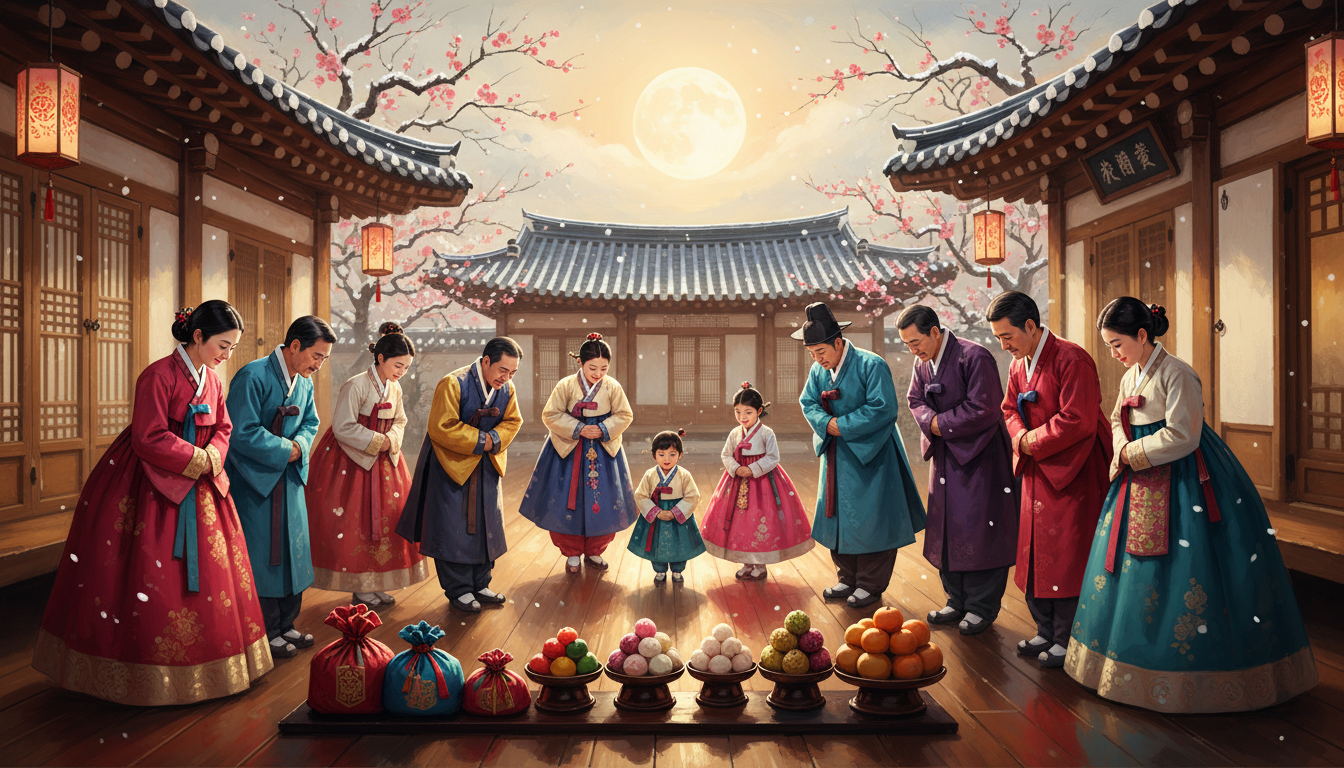
During Seollal, younger generations perform a deep, formal bow to their elders, a ritual known as Sebae. Children and young adults kneel on the floor and place their hands in front of them, bowing low to wish the elders a happy new year. This act reinforces the Confucian hierarchy and strengthens the bonds between different generations of the family.
6. Sebaetdon: The Joy of New Year’s Money
After performing the Sebae bow, children are often rewarded with Sebaetdon, or New Year’s money. This money is usually given in crisp, new bills and is often tucked into beautiful silk pouches. Along with the money, elders provide ‘Deokdam,’ which are words of wisdom or blessings for the recipient’s success and health in the upcoming year.
7. Hanbok: Wearing Cultural Identity
While many Koreans wear modern clothing daily, Seollal is a time when many choose to wear Hanbok, the traditional Korean attire. These garments are known for their vibrant colors and simple lines without pockets. Wearing Hanbok during the holiday is a way to express cultural pride and maintain a connection to historical Korean aesthetics during formal ceremonies.
8. Yutnori: The Ultimate Family Board Game
Entertainment during Seollal often revolves around Yutnori. This traditional board game uses four wooden sticks instead of dice. Depending on how the sticks land, players move their markers around a square board. It is a highly social game that involves strategy, luck, and plenty of cheering, making it a staple of family gatherings across the country.
9. Gwi-seong: The Great Migration Home
One of the most modern ‘facts’ of Seollal is the massive traffic congestion known as Gwi-seong. Millions of people travel simultaneously to reach their ancestral homes. Train tickets are often booked months in advance within minutes of going on sale, and highways that usually take four hours to traverse can take upwards of ten hours during the peak of the Seollal rush.
10. The Evolution of Gift Giving
Gift-giving is a major part of the holiday, but the items have evolved. While traditional gifts included fresh fruit or meat, modern Seollal gift sets are diverse.
- Spam Sets: Surprisingly, high-end Spam gift sets are incredibly popular.
- Health Supplements: Red ginseng is a top choice for elders.
- Toiletries: Practical sets containing shampoo and toothpaste are common corporate gifts.
11. Sol-bim: Starting Fresh with New Clothes
Traditionally, people would prepare new clothes called Sol-bim to wear on Seollal morning. This symbolizes casting off the old and welcoming the new. While the practice of making new clothes by hand has faded, many people still buy a new outfit or a new pair of shoes to mark the beginning of the lunar year.
12. Bokjumeoni: Carrying Good Fortune
To attract luck, Koreans often carry or gift Bokjumeoni, which are small silk pouches embroidered with symbols of longevity and wealth. These ‘lucky pouches’ are believed to bring good fortune to the wearer throughout the year and are a popular souvenir for tourists visiting Korea during the festive season.
13. Deokdam: The Power of Positive Words
As mentioned earlier, Deokdam refers to the blessings shared by elders. Common phrases include ‘Saehae bok mani badeuseyo’ (Please receive much luck in the New Year). These words are taken seriously, as it is believed that speaking positive outcomes into existence on the first day of the year helps ensure they actually happen.
14. The Zodiac Connection
Each Seollal is associated with one of the twelve zodiac animals (Rat, Ox, Tiger, Rabbit, Dragon, Snake, Horse, Goat, Monkey, Rooster, Dog, and Pig). People often look at the characteristics of the year’s animal to predict the general ‘vibe’ of the year. For example, the Year of the Dragon might be seen as a time for bold moves and power.
15. Neolttwigi: The Traditional Seesaw
A historical outdoor activity associated with Seollal is Neolttwigi, a type of seesaw jumping. Unlike Western seesaws where you sit, Neolttwigi involves standing on the ends of a wooden board and jumping to propel the person on the other side into the air. Legend says that women in the past used this to catch a glimpse of the world outside their high garden walls.
16. Yeonnaligi: Releasing Bad Luck
Kite flying, or Yeonnaligi, is a popular Seollal tradition, especially for children. People often write messages on the kites, such as ‘bad luck away, good luck stay.’ Once the kite is high in the sky, they sometimes cut the string, symbolizing the release of the previous year’s misfortunes into the wind.
17. Jegichagi: Testing Agility
Jegichagi is a game similar to hacky sack, where players kick a ‘jegi’ (a weighted object decorated with paper or fabric) to keep it in the air as long as possible. It requires great coordination and is a common sight in parks and family courtyards during the New Year holidays.
18. Preparation: The Rush at Traditional Markets
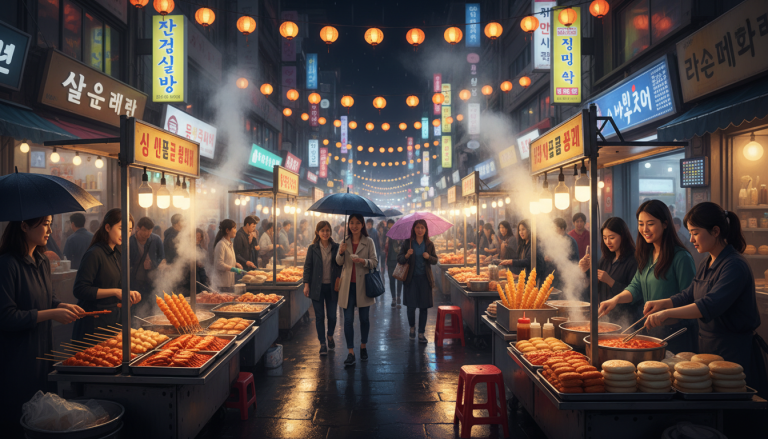
In the week leading up to Seollal, traditional markets like Namdaemun or Gwangjang become incredibly crowded. Families flock there to buy the freshest ingredients for the Charye table. The atmosphere is electric, filled with the smells of frying Jeon (savory pancakes) and the sounds of vendors shouting their best prices.
19. Seollal in North Korea
While the traditions originated in a unified Korea, Seollal was actually suppressed in North Korea for several decades in favor of the Gregorian New Year. However, it was reinstated as a holiday in the late 1980s. While some rituals differ, the core concept of visiting family and eating Tteokguk remains consistent across the peninsula.
20. The Superstition of the Night Spirit
An old folklore tale suggests that on the first night of the New Year, a spirit named Yagwang-gwi comes down to earth to steal shoes. If the spirit finds a pair that fits, it takes them, bringing bad luck to the owner for the rest of the year. To prevent this, people used to hide their shoes indoors or place a sieve over their doors to distract the spirit.
21. Hangwa and Yakgwa: Festive Sweets
No Seollal feast is complete without traditional sweets. Hangwa (traditional grain snacks) and Yakgwa (honey-fried cookies) are staples. These treats are not only delicious but are also aesthetically pleasing, often used to decorate the ancestral offering table due to their intricate shapes and natural colors.
22. Sinsu-daegil: Seeking Fortunes
Many Koreans visit fortune tellers or use traditional methods to check their Tojeong-bigyeol (yearly horoscope) during Seollal. It is a time of reflection and looking forward, where people seek guidance on career, love, and health for the next twelve months based on their birth date and time.
23. Sikhye and Sujeonggwa: Traditional Drinks
After a heavy meal of Tteokguk and Galbi-jjim (braised short ribs), Koreans enjoy traditional drinks. Sikhye is a sweet rice drink that aids digestion, while Sujeonggwa is a spicy cinnamon and ginger punch. Both are served cold and provide a refreshing end to the holiday feasts.
24. Modern Trends: The Rise of ‘Hon-sol’
Recently, a new trend has emerged called Hon-sol (drinking or celebrating alone). Some younger Koreans, overwhelmed by the pressure of family questions about marriage or jobs, choose to spend Seollal alone or traveling abroad. This has led to an increase in ‘Seollal travel packages’ to places like Japan or Southeast Asia.
25. Global Recognition of Seollal
As the Korean Wave (Hallyu) spreads, Seollal is gaining international recognition. Major cities worldwide now host Seollal festivals, and luxury brands often release limited-edition products themed around the Korean Lunar New Year. It is no longer just a local holiday but a global celebration of Korean heritage.
Conclusion: A Timeless Tradition
Seollal remains the heartbeat of Korean culture, bridging the gap between the ancient past and the high-tech present. Whether it is through the solemnity of the Charye ritual or the laughter during a game of Yutnori, the holiday reinforces the importance of family and the hope for a prosperous future. Understanding these 25 facts provides a window into the soul of Korea, revealing a society that deeply values its roots while moving confidently into the future.